
NJ Child Support Calculator: Free Estimate Based on NJ Guidelines
New Jersey Child Support Calculator
Free New Jersey estimate — Income Shares guideline model (estimate)
If you’re a parent in New Jersey trying to figure out what child support might look like after a separation or divorce, this child support calculator NJ tool gives you a fast, private estimate. Just enter both parents’ income, the number of children, and a few other details — you’ll get an estimated monthly payment in seconds, no sign-up required.
New Jersey doesn’t leave child support to guesswork. The state uses a formal formula called the Income Shares Model, written into New Jersey Court Rule 5:6A and Appendix IX of the state’s Rules of Court. This tool is built around that same underlying approach, so the number you see reflects how New Jersey actually thinks about child support — not a generic national average.
Below, you’ll find a plain-English breakdown of how the calculation works, what counts as income, how parenting time changes the number, and answers to the questions NJ parents ask most.
How This NJ Child Support Calculator Works
Enter these details and the calculator does the rest:
- Your gross monthly income and the other parent’s gross monthly income — wages, salary, bonuses, self-employment income, and other regular earnings.
- Number of children the calculation covers.
- Who is the paying parent — the parent with less parenting time is usually the one who pays.
- Parenting time percentage — roughly how many overnights per year the paying parent has with the child.
- Other children you already support — an existing support order lowers your available income for this calculation.
- Health insurance and childcare costs for the child, which get added on top of the base amount and split between both parents.
The calculator combines both incomes, applies an income-shares formula to find a base child support obligation, splits that obligation based on each parent’s share of the combined income, adjusts for parenting time, and adds each parent’s share of health insurance and childcare costs.
A note on accuracy: New Jersey’s official worksheets (Appendix IX-B and IX-C) run on net weekly income and apply detailed rules — including a separate Shared Parenting Worksheet, age-based adjustments, and a combined income cap. This calculator uses gross monthly income and a simplified income-shares formula to give you a fast ballpark figure. It’s a starting point for planning and conversation — not a substitute for the official worksheet a New Jersey court would use. For a number you can rely on in a filing, run the official guidelines or speak with a family law attorney.
How New Jersey Actually Calculates Child Support
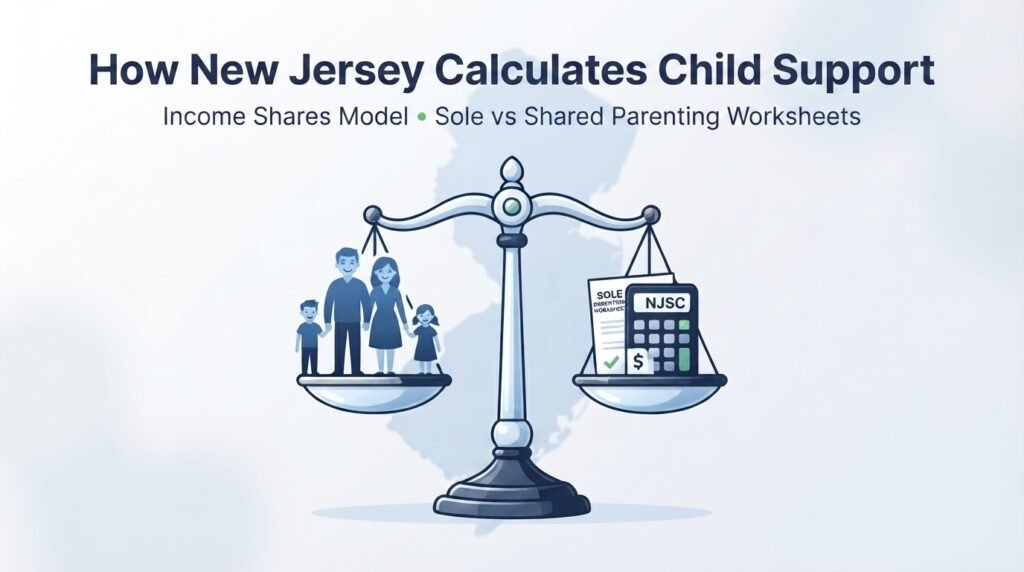
New Jersey’s real guideline calculation, for context, works like this:
1. It starts with both parents’ net income. Not gross pay — net income after taxes, mandatory retirement contributions, and other required deductions. The court combines both parents’ net weekly incomes to get a household total.
2. It picks a worksheet based on parenting time.
- The Sole Parenting Worksheet applies when the non-custodial parent has the child for fewer than 104 overnights a year (less than roughly 28%).
- The Shared Parenting Worksheet applies once the non-custodial parent reaches 104+ overnights a year (about two or more overnights a week, on average).
3. It looks up a base obligation. New Jersey publishes a chart — Appendix IX-F — showing the basic child support amount for different combined income levels and different numbers of children. The guidelines apply up to a combined net income cap of $3,600 per week (about $187,200 a year); above that, the court has more discretion.
4. It splits the amount by income share. Each parent pays a percentage of the total obligation equal to their percentage of the combined income. A parent earning 60% of the household’s combined income generally covers 60% of the base child support figure.
5. It layers on adjustments. Health insurance premiums for the child, work-related childcare, and other factors (like a child over age 12, or a parent already supporting other children) can shift the final number up or down.
What Counts as Income in NJ Child Support
New Jersey’s guidelines define income broadly. Along with regular wages and salary, the court can count bonuses, commissions, self-employment earnings, pensions, Social Security, unemployment or disability benefits, rental income, and investment income.
What is imputed income in NJ child support? If a parent is unemployed, underemployed, or appears to be voluntarily earning less than they’re capable of, the court can “impute” income — meaning it assigns an income figure based on that parent’s work history, education, and earning potential, rather than what they’re actually reporting. This is meant to stop a parent from artificially lowering their support obligation by choosing not to work.
Parenting Time and Shared Custody
Parenting time has a direct effect on the final number, because it reflects how much of the child’s day-to-day costs each household is already covering.
50/50 custody child support in NJ: When both parents share overnights close to equally, New Jersey courts recognize that both households are independently covering fixed costs like housing and utilities for the child. The Shared Parenting Worksheet accounts for this by adjusting the base obligation — it doesn’t erase support, but it typically reduces it compared to a sole-parenting arrangement, especially when incomes are close.
Crossing the 104-overnight mark (roughly 28% of the year) is one of the more consequential thresholds in NJ child support, since it changes which worksheet applies.
What Does Child Support Cover in NJ?
New Jersey’s guideline amount is built to cover a child’s everyday living costs — housing, food, clothing, transportation, entertainment, and other ordinary expenses. On top of the base guideline number, courts commonly add:
- The child’s share of health, dental, and vision insurance premiums
- Work-related childcare costs
- Predictable, recurring extraordinary expenses (like a documented ongoing medical need)
Costs like private school tuition or college expenses are usually treated separately from the base guideline figure — see below.
Child Support and College Expenses in NJ
Reaching college age doesn’t automatically end a parent’s support obligation in New Jersey. Courts can order continued support — including a contribution toward college costs like tuition, room, and board — for a child enrolled full-time in college or a vocational program, generally up to age 23. How much each parent contributes toward college depends on both parents’ finances, the child’s own resources (like financial aid or savings), and the specific school costs involved. It’s treated as a separate question from the standard monthly guideline calculation.
When Does Child Support End in New Jersey?
Does child support end at 18 in NJ? No. Turning 18 makes a child a legal adult, but it doesn’t automatically stop support.
What age does child support end in NJ? Under New Jersey law, child support is presumed to end at age 19, unless a parent asks the court to extend it. Support can continue past 19 — up to age 23 — if the child is still in high school, enrolled full-time in college or vocational training, or has a disability that existed before adulthood.
Does NJ child support go to 23? It can, but not automatically past 19. A parent typically needs to show the court that one of the extension conditions applies. New Jersey law is clear that, with limited exceptions for disability, support cannot continue past a child’s 23rd birthday.
Frequently Asked Questions
Is this NJ child support calculator official?
No. This tool provides an independent estimate based on New Jersey’s income-shares approach. It is not connected to the New Jersey courts or the NJ Child Support Program, and it doesn’t replace the official Appendix IX worksheets a judge would use.
What’s the difference between the Sole Parenting and Shared Parenting Worksheets?
The Sole Parenting Worksheet is used when one parent has the child most of the time (the other parent has fewer than 104 overnights a year). The Shared Parenting Worksheet applies once the non-custodial parent reaches 104 or more overnights a year, and it factors in that both parents are separately covering some of the child’s day-to-day costs.
Can parents agree to a different amount than the guidelines suggest?
Parents can agree to a different figure and include it in a settlement or parenting plan, but a judge still has to review and approve it. Courts generally won’t approve an amount that leaves a child without adequate support.
What happens if a parent falls behind on payments? Unpaid child support becomes “arrears” and can be enforced through wage garnishment, license suspension, tax refund interception, and other tools through the New Jersey Child Support Program. Falling behind doesn’t reduce the amount owed — only a court order can formally change a support obligation going forward.
Can child support be changed later?
Yes. Either parent can ask the court to modify an existing order if there’s been a substantial, ongoing change in circumstances — a significant income change, a change in parenting time, or a change in the child’s needs, for example.
Disclaimer: This calculator and the information above are provided for general estimation and educational purposes only. They are not legal advice and should not be relied on as a substitute for the official New Jersey child support guidelines or advice from a licensed New Jersey family law attorney. For a support figure that will hold up in court, use the official Appendix IX worksheets or consult an attorney familiar with your county’s family court.