
Virginia Child Support Calculator (2026 Guidelines)
Get a free, instant estimate of Virginia child support using the official schedule under Va. Code § 20-108.2. Just enter both parents’ income, custody time, and any health insurance or childcare costs — the calculator below runs the same statewide guideline table Virginia courts use, updated for the schedule that took effect July 1, 2025.
Virginia Child Support Calculator
Free Virginia estimate — Official Va. Code § 20-108.2 Guideline Table
This estimate is a starting point, not a court order. Judges can apply one of 15 deviation factors under Va. Code § 20-108.1 to adjust the final number, so treat the result as a well-informed guideline figure rather than a guarantee.
How to Use This Virginia Child Support Calculator
- Enter both parents’ gross monthly income — before taxes, from all sources (wages, self-employment, bonuses, disability, etc.).
- Enter the number of children the two of you share.
- Enter parenting time — roughly what share of overnights the paying parent has each year.
- Add any health insurance premium or childcare cost paid for the children.
- Click Calculate to see the estimated monthly payment, based on Virginia’s official guideline schedule.
The tool does the same core math a Virginia judge starts from: it combines both incomes, looks up the basic obligation on the statutory schedule, adds insurance and childcare, and splits the total by each parent’s share of income.
How Is Child Support Calculated in Virginia?
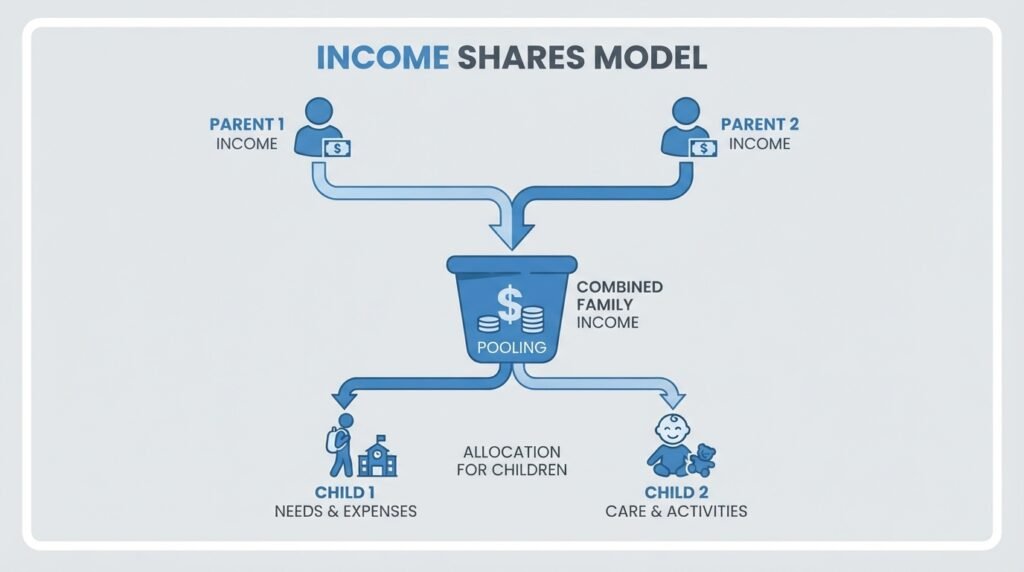
Virginia uses the income shares model. The idea behind it is simple: a child should get roughly the same share of parental income they would have received if both parents lived in one household. In practice, the court works through it in a few steps.
Step 1 — Add up gross monthly income. Both parents’ income is combined into one number. “Gross” means before taxes or deductions, and it covers wages, salary, self-employment earnings, bonuses, commissions, retirement and disability benefits, and most other regular income. If a parent already pays support for children from a different relationship, that amount can reduce their income for this calculation.
Step 2 — Look up the basic obligation. The combined income and the number of children point to a dollar figure on Virginia’s statewide schedule — this is the “basic child support obligation” before anything else is added.
Step 3 — Add health insurance and childcare. Whatever either parent pays for the children’s health coverage or work-related childcare gets added to the basic obligation.
Step 4 — Split it by income share. Each parent’s percentage of the combined income determines their share of the total obligation. A parent earning 65% of the combined income generally covers 65% of the support figure.
Step 5 — Adjust for parenting time. How much this final number moves depends on the custody arrangement — see below.
Sole, Shared, and Split Custody: Why the Formula Changes
Virginia doesn’t use one formula for every family. The custody arrangement decides which worksheet applies, and it’s the single biggest factor that changes the outcome.
Sole custody — one parent has the child fewer than 90 days a year. The other parent’s income share of the basic obligation (plus add-ons) becomes their support payment. This is the most common and most straightforward calculation.
Shared custody — both parents have the child 90 days a year or more (roughly 25% of overnights). Because both households are covering everyday costs, Virginia’s official worksheet (form DC-640) multiplies the basic obligation by 1.4 before dividing it by income and parenting-time shares between the two parents, then nets the two obligations against each other. This is a genuinely different calculation, not just a discount on the sole-custody number.
Split custody — each parent has primary physical custody of at least one child (for example, two children, one living mostly with each parent). The court runs the guideline separately for each household and the parent who owes more pays the difference.
A quick note on accuracy: this calculator applies Virginia’s official basic obligation schedule and gives a simplified adjustment once a parent’s time crosses roughly 20%. It does not run the full 1.4× shared-custody cross-credit worksheet (DC-640) that a Virginia court uses once both parents pass the 90-day threshold. If your case is close to 90 days a year or shared custody applies, treat this tool’s number as a rough range and confirm the exact figure with the official DC-640 worksheet or a family law attorney — the 1.4 multiplier can move the final number more than people expect.
Virginia’s 2025–2026 Guideline Update, in Plain Terms
Virginia’s basic obligation schedule was updated effective July 1, 2025 under SB 805 — the first change to the underlying dollar amounts in more than a decade. Two things changed:
- The income cap on the schedule rose from $35,000 to $42,500 in combined monthly gross income.
- Guideline amounts increased at nearly every income level to reflect over ten years of inflation.
If your order was entered or modified on or after July 1, 2025, it already reflects the new numbers. Orders from before that date don’t update automatically — a parent has to go back to court (or DCSE) and ask for a recalculation before the new schedule applies to their case. Going into 2026, no further schedule change has taken effect; the July 2025 table is still the current one.
What Counts as “Combined Income” for the Cap and Add-Ons?
Above the $42,500 combined monthly income cap, Virginia doesn’t leave the schedule blank — it switches to a set percentage of income per child rather than a table lookup. Below the cap, three things typically get layered onto the basic obligation:
- Health insurance — the cost attributable to the children specifically, not the whole family plan.
- Work-related childcare — daycare or after-school care tied to a parent’s job or job search.
- Extraordinary medical or other court-approved expenses, in some cases.
Both of these add-ons get prorated the same way as the base obligation — by each parent’s share of combined income.
Sample Basic Obligations From Virginia’s Official Schedule
These figures come straight from the current statutory schedule under Va. Code § 20-108.2. They show the combined basic obligation before it’s split between parents and before health insurance or childcare is added — useful for getting a feel for how the numbers scale with income, separate from running the full calculator above.
| Combined Monthly Gross Income | 1 Child | 2 Children |
|---|---|---|
| $3,000 | $554 | $836 |
| $5,000 | $872 | $1,304 |
| $8,000 | $1,121 | $1,642 |
| $12,000 | $1,420 | $2,059 |
So for “how much is child support for 1 kid in Virginia” — there’s no single flat number; it depends entirely on combined income. A family earning $3,000 combined a month and one earning $12,000 combined are on very different points of the same schedule, and the paying parent only owes their percentage share of that basic figure, not the whole amount.
What If a Parent Is Underemployed, Self-Employed, or Hiding Income?
This comes up in almost every contested case, so it’s worth addressing directly rather than treating it as a “loophole.”
Virginia courts can impute income to a parent who is voluntarily unemployed or voluntarily underemployed — meaning the court calculates support based on what that parent could reasonably be earning, not what they’re currently reporting. This is one of the 15 deviation factors under Va. Code § 20-108.1(B)(3), and it’s the one attorneys cite most often. A parent who quits a well-paying job or deliberately takes a lower-paying one to reduce support doesn’t get to lower their obligation that way — the court can run the guidelines on their prior or potential earnings instead.
There are limits: income generally can’t be imputed to a parent who is physically or mentally unable to work, or who is the primary caregiver for a child under three with no available childcare. Incarceration of 180+ consecutive days (outside specific exceptions) also isn’t automatically treated as voluntary unemployment.
For self-employed parents or anyone suspected of unreported cash income, courts can look past pay stubs to bank deposits, lifestyle, and spending patterns to establish real income. There’s no shortcut around this in the guidelines — it’s evidence-driven, and usually needs an attorney to build the record properly.
Beyond imputed income, the other deviation factors judges most commonly rely on include extraordinary medical expenses, a significant disparity in each parent’s other financial resources, and, in high-income cases, maintaining the standard of living the child would have had if the parents were still together (Virginia has no hard statutory ceiling on support amounts).
Does Fairfax, Richmond, or Any Other Virginia City Use a Different Formula?
No. Va. Code § 20-108.2 is a state statute, so the same schedule and formula apply whether the case is filed in Fairfax, Richmond, Great Falls, Virginia Beach, or anywhere else in the Commonwealth. What differs by locality isn’t the math — it’s things like local court scheduling, DCSE office wait times, and which family law attorneys practice there. If you’re searching for “child support guidelines Fairfax” specifically because your case is filed in Fairfax County, this same statewide calculator and schedule apply to you.
When Does Child Support End in Virginia?
Support generally ends when the child turns 18, or 19 if they’re still a full-time high school student — whichever comes first. A few things extend or complicate that:
- It doesn’t stop automatically. Reaching the age doesn’t cancel wage withholding or an existing order by itself — the paying parent (or DCSE) needs a court action to formally close it out. Stopping payments early because “the kid turned 18” without that paperwork can leave arrears on the books.
- Disabled adult children. Courts can order support to continue indefinitely for a child who is severely and permanently disabled and unable to live independently.
- Emancipation. Marriage, active military service, or a court-ordered emancipation can end support earlier.
- No college obligation. Unlike some states, Virginia courts cannot order a parent to pay for college. Any college-cost arrangement has to be a separate written agreement between the parents — it isn’t part of the child support order.
If you’re asking “how to stop child support in Virginia,” the short answer is: file a motion (or request through DCSE) once one of these conditions is met, keep paying until the order is officially modified or terminated, and don’t rely on the calendar alone.
Frequently Asked Questions
How much is child support for one child in Virginia?
It depends on both parents’ combined gross monthly income — there’s no flat statewide number. On the current schedule, the combined basic obligation for one child ranges from a few hundred dollars a month at lower income levels to well over a thousand dollars as combined income rises, before either parent’s individual share, health insurance, or childcare is factored in. Use the calculator above with your actual numbers for an accurate estimate.
How is child support calculated in Virginia?
Virginia combines both parents’ gross monthly income, looks up a basic obligation on the statutory schedule based on that income and the number of children, adds health insurance and childcare costs, then splits the total by each parent’s percentage share of the combined income. Shared custody (90+ days a year for both parents) changes the formula further.
What’s the difference between Virginia’s child support calculator for shared custody and sole custody?
Sole custody simply applies the paying parent’s income share to the basic obligation. Shared custody (both parents at 90+ days a year) multiplies the basic obligation by 1.4 to reflect two households’ costs, then nets each parent’s adjusted share against the other’s — which can meaningfully lower the paying parent’s number compared to a sole-custody calculation with the same income.
Can 50/50 custody eliminate child support entirely in Virginia?
Only in specific circumstances — mainly when both parents earn similar incomes and split costs like health insurance and childcare close to evenly. Equal time alone doesn’t zero out support if there’s a meaningful income gap between the parents.
How do I stop child support in Virginia?
You need a court order (or DCSE action) formally ending or modifying the obligation — reaching age 18, emancipation, or another qualifying event doesn’t stop it automatically. Continue paying until the change is official to avoid arrears.
Did Virginia’s child support laws change for 2025 or 2026?
Yes — the guideline schedule was updated effective July 1, 2025 (SB 805), raising the income cap to $42,500 combined monthly and increasing guideline amounts at most income levels. As of 2026, that July 2025 schedule remains current.
Is this calculator accurate for my county — Fairfax, Loudoun, Great Falls, or elsewhere?
Yes. Child support guidelines in Virginia are set by state statute, not by county, so the same schedule applies statewide.
Disclaimer: This calculator provides an estimate based on Virginia’s statutory guidelines and is not a substitute for legal advice. Courts can deviate from the guideline amount under Va. Code § 20-108.1, and only a judge — or a signed agreement between both parents — can set or change an actual support order. For a case-specific number, consult a Virginia family law attorney or the Division of Child Support Enforcement (DCSE).